Human Rights Commission of Malaysia (SUHAKAM)is an independent organisation which investigates complaints for the violation of human rights. Human rights is the fundamental rights of each person, regardless of heritage, race, skin color, religion, political views, believes or where we live.
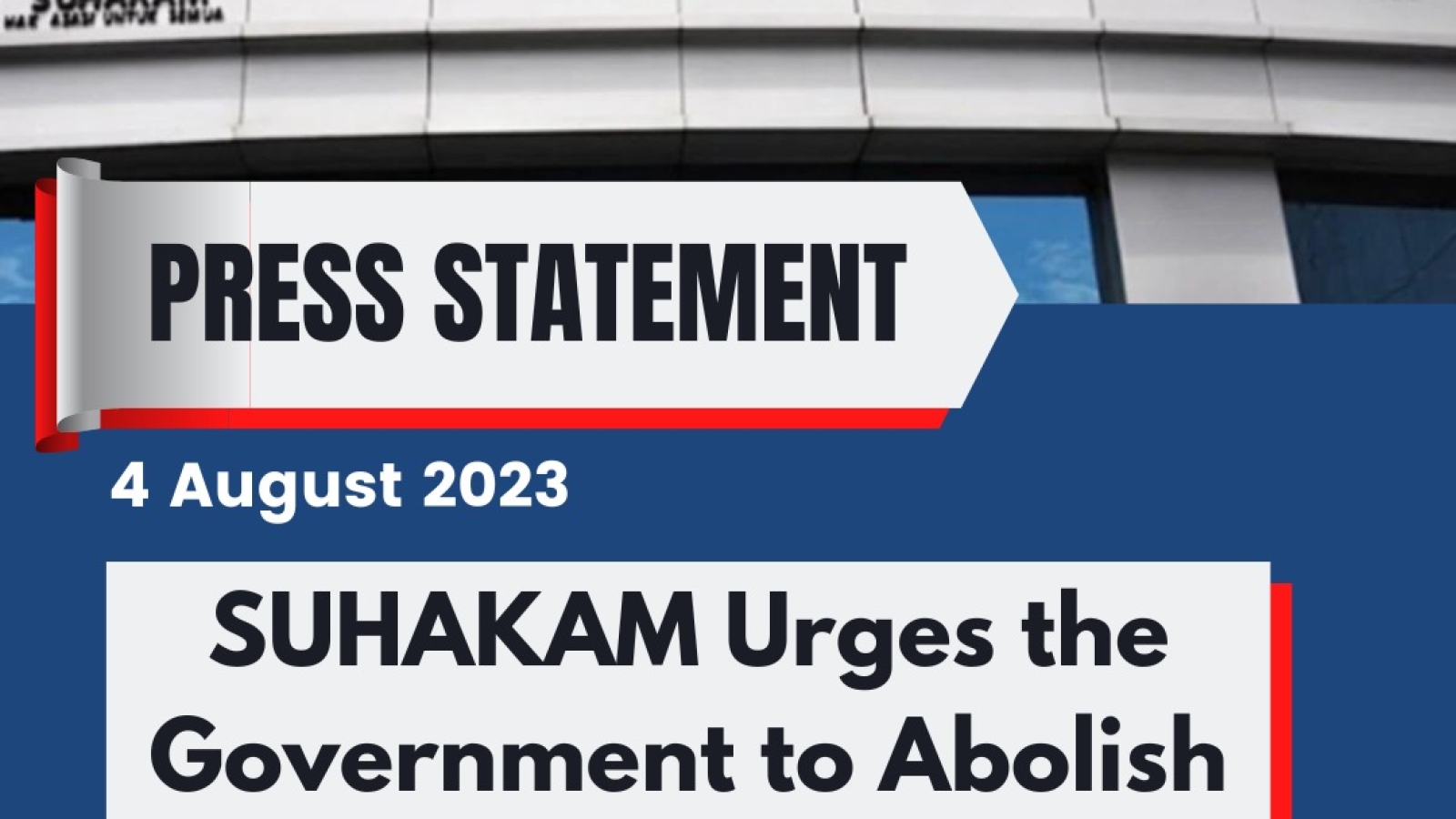
KUALA LUMPUR (4 AUGUST 2023) – The Human Rights Commission of Malaysia (SUHAKAM) reiterates its stance against the Security Offences (Special Measures) Act 2012 (SOSMA) and any draconian security laws that allow for detention without trial, as they contradict fundamental principles of human rights. Particularly, Section 4 of SOSMA permits arrest, detention, and extension of detention without requiring judicial oversight.
On 27th July 2023, SUHAKAM received a complaint memorandum concerning a planned hunger strike by SOSMA detainees in Sungai Buloh Prison and Alor Setar Prison, commencing on 30th July 2023. In response, SUHAKAM conducted a joint visit to both prisons on 1st August 2023, where we interviewed the SOSMA detainees and gathered more information about the hunger strike. Additionally, SUHAKAM assessed the health conditions of all detainees involved in the hunger strike, which included 35 detainees in Sungai Buloh Prison and 32 detainees in Alor Setar Prison.
The hunger strike was initiated due to the detainees’ dissatisfaction with the prolonged and frequently postponed trial process, as well as their objections to the charges under Section 130 V (1) of the Penal Code, which relates to organized criminal groups. The detainees are demanding that the charges be changed to Section 43 of the Societies Act 1966.
Based on the visit’s finding, the Prison authorities managed the hunger strike incident in accordance with the Standard Operating Procedures (SOP) set by the Headquarters of the Malaysian Prison Department. The detainees’ health conditions were also properly attended to by the Rehabilitation Officer at the Prison. Additionally, the visit did not reveal any incidents beyond the control of the involved SOSMA detainees.
SUHAKAM has been informed that the hunger strike at Alor Setar Prison was ended by the detainees on 1st August 2023 at 5:00 pm, and at Sungai Buloh Prison on 2nd August 2023 at 1:45 pm. SUHAKAM will continue its investigation into the complaints and will collaborate with the detainees’ families and relevant Government agencies to pursue further follow-up actions.
-END-
Prof. Dato’ Dr. Rahmat Mohamad
Chairman
Human Rights Commission of Malaysia (SUHAKAM)
4 August 2023
——————
KENYATAAN MEDIA
KUALA LUMPUR (4 OGOS 2023) – Suruhanjaya Hak Asasi Manusia Malaysia (SUHAKAM) menegaskan pendirian bahawa Akta Kesalahan Keselamatan (Langkah-langkah Khas) 2012 (SOSMA) dan mana-mana undang-undang keselamatan persis drakonian yang berkaitan dengan penahanan tanpa bicara adalah bertentangan dengan prinsip utama hak asasi manusia, di mana peruntukkan Seksyen 4 SOSMA membenarkan tangkapan, penahanan dan penambahan tempoh tahanan tidak memerlukan pemantauan kehakiman.
Pada 27 Julai 2023, SUHAKAM menerima satu memorandum aduan berkenaan rancangan mogok lapar oleh tahanan SOSMA yang berada di Penjara Sungai Buloh dan Penjara Alor Setar bermula 30 Julai 2023. Susulan memorandum tersebut, SUHAKAM membuat lawatan serentak ke Penjara Sungai Buloh dan Penjara Alor Setar pada 1 Ogos 2023 untuk berjumpa dan menemubual tahanan SOSMA serta mendapatkan maklumat lanjut mengenai mogok lapar yang dijalankan. Di samping itu, SUHAKAM juga melihat keadaan kesihatan semua tahanan yang terlibat dengan mogok lapar tersebut. Secara keseluruhannya, terdapat 35 orang tahanan SOSMA di Penjara Sungai Buloh dan 32 orang tahanan SOSMA di Penjara Alor Setar yang terlibat dalam mogok lapar tersebut.
SUHAKAM difahamkan bahawa tujuan utama mogok lapar ini dijalankan antara lainnya adalah kerana para tahanan tidak berpuas hati dengan proses perbicaraan yang mengambil masa terlalu lama dan sering kali ditunda, mereka tidak berpuas hati dengan pertuduhan di bawah Seksyen 130 V(1) Kanun Keseksaan iaitu penglibatan dengan kumpulan jenayah terancang serta menuntut agar pertuduhan kes ditukar kepada Seksyen 43 Akta Pertubuhan 1966.
Hasil lawatan tersebut mendapati bahawa pihak Penjara telah mengendalikan insiden mogok lapar ini mengikut SOP yang ditetapkan oleh Ibu Pejabat Jabatan Penjara Malaysia. Keadaan kesihatan tahanan juga telah diberikan perhatian yang sewajarnya oleh Pegawai Perubahan di Penjara. Selain itu, lawatan tersebut tidak menunjukkan sebarang perkara yang berlaku di luar kawalan ke atas tahanan SOSMA yang terlibat.
SUHAKAM telah menerima maklumbalas bahawa tindakan mogok lapar dihentikan oleh tahanan di Penjara Alor Setar pada 1 Ogos 2023 jam 5.00 petang dan Penjara Sungai Buloh pada 2 Ogos 2023 jam 1.45 petang. SUHAKAM akan meneruskan siasatan ke atas aduan tersebut dan akan bekerjasama dengan pihak keluarga tahanan serta agensi Kerajaan yang berkaitan sebagai tindakan susulan.
Imagine a world where human beings are traded like commodities, robbed of their freedom, and subjected to unspeakable horrors. It is a reality that exists in the shadows, hidden from the prying eyes of society. But today, we vow to bring this hidden world into the light, reach every victim of trafficking, and leave no one behind.
In this battle against human trafficking, education is the greatest weapon. Through awareness and understanding, we can empower ourselves and others to recognize the signs, break the silence, and take action. It’s about choosing to open our eyes, coming together, and saying, “Enough is enough!”
Is Forced Labour Human Trafficking?
Forced labour represents[1] a grim reality where victims are compelled or involuntarily made to work under harsh and exploitative circumstances. This distressing outcome often arises from human trafficking, where victims become vulnerable and controlled, leading to their exploitation in forced labour, resembling modern-day slavery. It is deeply intertwined with this insidious crime.
Like two sides of the same coin, they share a connection that cannot be ignored. In the minds of many, the terms “forced labour” and “trafficking in persons” are used interchangeably although they’re very distinct. It is a stark reminder that even within the intricate web of human trafficking, forced labour stands tall as a distinct but closely related manifestation of one of the most severe forms of exploitation that needs to be prohibited.
Back in 2015, the Human Rights Commission of Malaysia (SUHAKAM) and Fortify Rights had published a report entitled “Sold Like Fish”. This report was based on investigations carried out over a number of years involving large numbers of human trafficking victims from Myanmar and Bangladesh to Thailand and Malaysia from 2012 to 2015. The report contains stories and experiences of brave souls who have endured unimaginable pain and suffering.
—————–
“We only had skin and bones.” – Rohingya woman, 25, from Aung Mingalar, Sittwe
—————–
“Every day, someone died.” – “Rahim Ullah”, 16, Rohingya trafficking survivor, Kuala Lumpur, Malaysia, 2014
——————
Their resilience inspires us to fight for justice and to create a world where no one is forced into modern-day slavery.
The traffickers did not spare children from the beatings. A Rohingya widow, 27, and her five children from Sittwe Township in Myanmar’s Rakhine State boarded a ship operated by human traffickers in March 2015, she shared that:
“Sometimes, the crew would beat the children. My children were beaten. Whenever the children cried, they would be beaten. At lunchtime, when the children started to get hungry, they’d cry; at this time, the crew would beat them. The beating wasn’t very forceful, but the children would be in pain for a couple of days. Their skin bruised and became swollen.”
The survivor’s story is a powerful reminder of the resilience and determination that can arise in the face of unimaginable adversity. Their experience underscores the critical need to support and empower survivors, raise awareness, and hold traffickers accountable.
——————–
Twenty-year-old Foyas said he witnessed dozens of deaths during his three-week period of confinement in a makeshift human-trafficking camp on the Malaysia – Thailand border in early 2014:
“The rain caused many problems. Many people died. Many people were swelling.At least 30 people died.”
——————–
“Fatima”, 20, said traffickers beat her husband while they were at sea:
“The dallals beat people who asked for more food or water, including my husband.The dallals beat my husband at least five times. They hit him with a stick, and he suffered some bleeding and injuries. Some people were so thirsty, they started drinking seawater.“
——————–
We must remember that human trafficking knows no boundaries, it happens on the land and on the sea. It transcends borders, cultures, and social classes. It infiltrates our communities, preying on vulnerability and desperation.
Climate change significantly amplifies the risk of human trafficking, especially among marginalized communities. Environmental fluctuations exacerbate factors like economic challenges, gender and identity discrimination, inadequate legal safeguards, and ongoing conflicts, thereby increasing the vulnerability to human trafficking. Additionally, as climate change induces migration, the likelihood of human trafficking escalates, further impacting more severely certain groups, including migrants, women, children, and minority populations, who are more exposed to exploitation due to these circumstances.
Climate change increases the risk of natural disasters, exacerbates poverty, and creates conditions for conflict and instability. Combined with labour demand-supply mismatches and unscrupulous recruitment agencies, vulnerable populations resort to risky behaviours, falling prey to human trafficking and exploitation. Sadly, this climate-trafficking nexus remains overlooked in global discussions and policy frameworks.
Unwavering Hope:Malaysia’s Journey in Combating Human Trafficking
Even in the face of challenges, there is hope. Malaysia’s journey through the United States’ Department of State’s Trafficking in Persons (TIP) Report, is a tale of resilience and progress. Over the span of a decade, Malaysia underwent a transformative journey in combating human trafficking.
Initially placed in “Tier 3” in 2013-2014, the nation grappled with significant challenges. However, progress made in 2015-2016 propelled Malaysia to the “Tier 2 Watch List”, marking a notable improvement in its efforts. Malaysia was in “Tier 2” in 2017, indicating that the Government had made significant commitments to ensure improvement of its compliance. However, from 2018 to 2020, Malaysia was categorised on the Tier 2 Watch List and in 2021 and 2022 declined to Tier 3.
Yet, the narrative shifts towards hope again in 2023. Malaysia reclaims its position on the “Tier 2 Watch List”, showcasing progress in combating human trafficking.
These placements indicate how Malaysia is assessed by the U.S. Government in meeting the minimum standards for eliminating trafficking, as outlined by the Trafficking Victims Protection Act of 2000 (TVPA). “Tier 3” denotes the lowest compliance level, “Tier 2 Watch List” includes governments striving to meet Tier 2 standards but haven’t achieved full compliance as yet and “Tier 2” represents significant efforts towards compliance.
We can be the change-makers
In the light of this, SUHAKAM, together with Government agencies and supportive stakeholders have played a crucial role in raising awareness and combatting human trafficking in the country. The commission has noted its grave concern over the issue and has openly urged the Government to take effective measures by enhancing legal and regulatory frameworks to address human trafficking.
Education and awareness are emphasized by SUHAKAM as critical tools to tackle human trafficking. To this end, SUHAKAM has provided extensive training for law enforcement officials, civil society organizations, and the general public to increase their understanding of this issue and enhance their ability to combat it. In the realm of justice, SUHAKAM has been urging for full protection and assistance to be provided to trafficked and smuggled victims, aligned with international standards set by the United Nations Protocol to Prevent, Suppress and Punish Trafficking in Persons, Especially Women and Children.[4]
Bring the voices of hope for the voiceless
This year as we commemorate “World Day Against Trafficking in Persons”, we stand united with a shared purpose, let our commitment be to reach every victim of trafficking, leaving no one behind. From the standpoint of SUHAKAM, we wholeheartedly offer our strong support and unwavering encouragement in the fight against trafficking in persons. Complaints regarding human trafficking have constantly been lodged with SUHAKAM over the years. Although it is not an enforcement agency for transnational crimes, SUHAKAM has been acting as a bridge between complainants and enforcement agencies to ensure that immediate and appropriate action is taken on every complaint. SUHAKAM also regularly inspect shelters for trafficking victims, advocating for heightened awareness and upholding their human rights from rescue to rehabilitation and reintegration into society.
Together, we can protect the rights and dignity of every individual, eradicate trafficking networks, and provide the necessary support for survivors to rebuild their lives. Let’s create a world where no one falls victim to such atrocities, and where human rights are upheld for all.
[1] International Labour Organization (ILO) Forced Labour Convention, 1930 (No. 29), Article 2(1) defines forced labour as: “all work or service which is exacted from any person under the menace of any penalty and for which the said person has not offered himself [or herself] voluntarily”.
[2] “Sold Like Fish” Crimes Against Humanity, Mass Graves, and Human Trafficking from Myanmar and Bangladesh to Malaysia from 2012 to 2015 (2019)
KUALA LUMPUR (26 JULY 2023) – The Human Rights Commission of Malaysia (SUHAKAM) supports the Government’s initiative to establish a Malaysian Gig Economy Commission (SEGiM) and formulate legislation aimed at safeguarding the social security of gig workers. This significant development aligns seamlessly with SUHAKAM’s recommendations to ensure adequate social protection for gig workers.
The gig economy in Malaysia has experienced remarkable growth in recent years. However, the lack of clear worker classification and agreed-upon terms of employment has hindered gig workers from enjoying basic labour rights and essential social protections. Additionally, concerns about consumer rights and food safety have arisen due to the unique nature of gig-based services.
Recognizing these challenges, SUHAKAM initiated efforts in 2021 to actively advocate for the rights of workers in the gig economy. As part of these ongoing endeavours, extensive consultations have been conducted with e-hailing and p-hailing workers, including a recent series of consultations held on 1st March 2023 and 1st June 2023, with active participation from e-hailing and p-hailing service providers.
In full support of this progressive plan, SUHAKAM is ready and committed to actively participate in the consultation process for the formulation of the legislation, ensuring that the rights of gig workers and consumer interests are well balanced and protected.
SUHAKAM proposes that the following matters be seriously considered, among others, clear definitions of gig workers, social protection, complaint mechanisms, and collective agreement terms of employment, such as income stability, maternity leave, annual leave, medical benefits, contributions to the Social Security Organisation (SOCSO), Employee Provident Fund (EPF), and insurance coverage, as well as adequate floor and fair pay. Furthermore, legislation should also include specific provisions for consumer rights and food hygiene preparation in gig-based services to foster a safe and reliable environment for both workers and consumers.
SUHAKAM strongly encourages continued dialogue and collaboration between the Government, industry stakeholders, gig workers’ associations, and civil society organizations to address the evolving needs of gig workers while upholding consumer rights and ensuring food safety. By working together, we can establish a fair, inclusive, and secure system that protects the rights, welfare, and interests of all stakeholders involved in the gig economy.
-END-
Prof. Dato’ Dr. Rahmat Mohamad
Chairman
Human Rights Commission of Malaysia (SUHAKAM)
26 July 2023
—————-
KENYATAAN MEDIA
KUALA LUMPUR (26 JULAI 2023) – Suruhanjaya Hak Asasi Manusia Malaysia (SUHAKAM) menyokong inisiatif Kerajaan untuk menubuhkan Suruhanjaya Ekonomi Gig Malaysia (SEGiM) serta menggubal undang-undang yang bertujuan untuk melindungi keselamatan sosial pekerja gig. Perkembangan penting ini sejajar dengan cadangan SUHAKAM bagi memastikan perlindungan sosial yang mencukupi untuk pekerja gig.
Ekonomi gig di Malaysia telah mengalami pertumbuhan yang luar biasa dalam beberapa tahun kebelakangan ini. Walau bagaimanapun, kekurangan klasifikasi pekerja gig yang jelas dan syarat-syarat pekerjaan yang dipersetujui telah menghalang pekerja gig daripada menikmati hak asasi pekerja dan perlindungan sosial. Di samping itu, kebimbangan mengenai hak pengguna dan pengendalian makanan timbul kerana ciri unik perkhidmatan berasaskan gig.
Menyedari cabaran ini, SUHAKAM memulakan usaha pada tahun 2021 secara aktif menyokong hak pekerja dalam ekonomi gig. Oleh itu, bagi meneruskan usaha ini, dua siri rundingan telah dijalankan iaitu pada 1 Mac 2023 dengan pekerja e-panggilan dan p-panggilan serta pada 1 Jun 2023 melibatkan syarikat penyedia perkhidmatan e-panggilan dan p-panggilan.
Dalam menyokong penuh usaha progresif ini, SUHAKAM bersedia dan komited untuk mengambil bahagian secara aktif dalam proses rundingan untuk menggubal undang-undang bagi memastikan hak pekerja gig dan kepentingan pengguna dilindungi secara seimbang.
SUHAKAM mencadangkan agar perkara-perkara berikut dipertimbangkan dengan serius termasuk definisi yang jelas mengenai pekerja gig, perlindungan sosial, mekanisme aduan dan terma syarat perjanjian kolektif pekerjaan termasuk kestabilan pendapatan, cuti bersalin, cuti tahunan, faedah perubatan, sumbangan kepada Pertubuhan Keselamatan Sosial (PERKESO) dan Kumpulan Wang Simpanan Pekerja (KWSP), perlindungan insurans, serta kadar tambang lantai yang adil dan mencukupi. Selain itu, undang-undang juga harus merangkumi peruntukan khusus kepada hak pengguna dan pengendalian makanan dalam perkhidmatan berasaskan gig untuk memupuk persekitaran yang selamat bagi pekerja serta pengguna.
SUHAKAM amat menggalakkan dialog dan kerjasama berterusan antara kerajaan, pihak berkepentingan industri, persatuan pekerja gig dan organisasi masyarakat sivil untuk menangani keperluan pekerja gig yang sentiasa berkembang sambil mendukung hak pengguna dan memastikan pengendalian makanan yang selamat. Kita harus bekerjasama bagi mewujudkan sistem yang adil, inklusif dan selamat dalam melindungi hak, kebajikan dan kepentingan semua pihak yang terlibat dalam ekonomi gig.
KUALA LUMPUR (24 JULY 2023) – The Human Rights Commission of Malaysia (SUHAKAM) condemns the unacceptable behavior displayed by The 1975’s lead singer, Matty Healy, on all counts. His reckless behavior on stage that had caused the event to be cancelled has had negative consequential economic impact to many other artists and vendors.
SUHAKAM welcomes the Government’s initiative to ensure that the other artists and vendors impacted by the cancellation of the Good Vibes Festival, would be provided with some assistance.
While SUHAKAM advocates equality for all and freedom of expression, it is important to stress that these rights must be practiced responsibly and within any restrictions imposed by local laws and cultural considerations. Any limitations on freedom of expression should be proportionate and in accordance with the human rights standards enshrined in the Federal Constitution as national security and public order are vital concerns.
Throughout the years, Malaysia has successfully hosted numerous artists who have demonstrated respect for our local laws and cultural norms during their performances. SUHAKAM commends these artists for their responsible behavior and adherence to our country’s regulations.
As a National Human Rights Institution (NHRI) dedicated to promoting tolerance, and a cohesive society, SUHAKAM calls upon all individuals to express themselves responsibly and refrain from engaging in acts of intolerance and hatred. Embracing cultural diversity is essential for fostering harmony in our society.
SUHAKAM concludes by emphasizing the value of maintaining human rights, cultural sensitivity, and legal compliance. By doing so, we are able to build a society that respects everyone’s rights and dignity while still valuing our rich cultural history.
-END-
Prof. Dato’ Dr. Rahmat Mohamad
Chairman
Human Rights Commission of Malaysia (SUHAKAM)
24 July 2023
—————–
KENYATAAN MEDIA
KUALA LUMPUR (24 JULAI 2023) – Suruhanjaya Hak Asasi Manusia Malaysia (SUHAKAM) mengecam perbuatan jelik yang ditunjukkan oleh penyanyi utama The 1975, Matty Healy. Tindakan semberono beliau semasa di atas pentas telah menyebabkan acara tersebut dibatalkan dan memberi kesan ekonomi yang negatif kepada ramai artis dan pengusaha vendor.
SUHAKAM mengalu-alukan inisiatif Kerajaan yang mengumumkan bantuan untuk artis dan vendor yang terjejas akibat pembatalan Festival Good Vibes.
Walaupun SUHAKAM menyokong kesaksamaan kepada semua dan kebebasan bersuara kepada semua, adalah penting untuk menekankan bahawa hak asasi ini mesti diamalkan secara bertanggungjawab dan dalam sekatan yang terdapat dalam undang-undang serta pertimbangan budaya tempatan. Sebarang batasan kepada kebebasan bersuara hendaklah seimbang dan tertakluk kepada piawaian hak asasi manusia yang termaktub dalam Perlembagaan Persekutuan kerana keselamatan negara dan ketenteraman awam adalah perkara yang amat dititik beratkan.
Bertahun-tahun Malaysia telah berjaya menjadi tuan rumah kepada pelbagai artis yang telah menunjukkan penghormatan terhadap undang-undang dan norma budaya tempatan semasa persembahan mereka. SUHAKAM memuji artis-artis ini atas tingkah laku serta tanggungjawab mereka dalam mematuhi peraturan negara.
Sebagai sebuah Institusi Hak Asasi Manusia Kebangsaan (NHRI) yang komited dalam mempromosikan toleransi, dan masyarakat yang bersatu padu, SUHAKAM menyeru semua individu untuk menyatakan pandangan masing-masing dengan bertanggungjawab dan mengelakkan dari sebarang tindakan yang tidak bertoleransi dan kebencian. Menerima kepelbagaian budaya adalah penting untuk memupuk keharmonian dalam masyarakat kita.
Dengan menekankan nilai hak asasi manusia, sensitiviti budaya, dan pematuhan undang-undang, kita dapat membina masyarakat yang menghormati hak dan maruah semua individu dan pada masa yang sama menghargai sejarah yang kaya dengan budaya.
-TAMAT-
Prof. Dato’ Dr. Rahmat Mohamad Pengerusi Suruhanjaya Hak Asasi Manusia Malaysia (SUHAKAM) 24 Julai 2023
KUALA LUMPUR (12 JULY 2023) – In response to the recent suit filed against the Ministry of Health, this office would like to reiterate our stance which is also reflective on our earlier statement regarding the delisting of nicotine from the Poison Act 1952 [Act 366].
The consequential effect of the delisting is not unthinkably distant nor remote. Children and Young people will have unhindered access to the consumption of nicotine which could see an explosive number of youth addictions to nicotine-related products in no time. The situation will only worsen when they are also likely to be exposed to illicit substance or super-strength nicotine when consuming the products.
The perilous policy move that monetised the health and well-being of children and young people to trade on the increment of tax revenue was ineptly devised. Child-rights approach in policy-formulation is under-emphasised and should be stressed in the context of substance control. The scientific understanding of harm associated by nicotine has to be rigorously studied and disseminated accessibly to the wider public particularly children.
‘As the mouthpiece for the children on matters affecting them, I would like to urge that the government has the obligation to get it right, which is relisting nicotine back to the scheduled list of Act 366. When it comes to the protection of their health, the children in Malaysia deserve no less.’
-END-
Dr Farah Nini Dusuki
Children’s Commissioner
12 July 2023
—————-
KENYATAAN MEDIA
KUALA LUMPUR (12 JULAI 2023) – Pejabat Pesuruhjaya Kanak-Kanak sekali lagi ingin menegaskan pendiriannya seperti yang dinyatakan di dalam kenyataan sebelum ini berhubung dengan penyahsenaraian nikotin daripada Akta Racun 1952 [Akta 366].
Kesan berbangkit daripada penyahsenaraian ini sangat jelas. Kanak-kanak dan golongan belia akan mendapat akses yang tidak terbatas kepada nikotin yang seterusnya akan meningkatkan jumlah ketagihan kepada produk berasaskan nikotin dalam kalangan belia secara mendadak. Situasi hanya akan menjadi lebih buruk apabila mereka juga berkemungkinan terdedah kepada bahan terlarang atau nikotin yang kuat ketika menggunakan produk berkenaan.
Langkah perubahan dasar yang membahayakan kesihatan dan memperdagangkan kesejahteraan kanak-kanak serta golongan belia demi peningkatan hasil cukai ini adalah satu langkah yang tidak bijak. Selain itu, pendekatan hak asasi kanak-kanak dalam penggubalan dasar juga kurang diberikan penekanan. Perkara ini sepatutnya diberi perhatian yang lebih khususnya dalam konteks kawalan bahan terkawal. Pemahaman saintifik tentang bahaya yang dikaitkan dengan nikotin haruslah dikaji dengan teliti dan disebarkan kepada khalayak yang lebih luas khususnya kepada kanak-kanak.
Sebagai jurucakap yang mewakili kanak-kanak bagi perkara yang memberikan kesan kepada mereka, Pesuruhjaya Kanak-kanak (CC) ingin menggesa supaya kerajaan menjalankan kewajipannya dalam memperbaiki keadaan ini dengan menyenaraikan semula nikotin ke senarai berjadual dalam Akta 366. Kanak-kanak di Malaysia mempunyai hak yang sama dengan seluruh lapisan masyarakat khususnya melibatkan perlindungan kepada kesihatan mereka.
KUALA LUMPUR (11 JULY 2023) – The Children’s Commissioner (CC) reminds parents or guardians on their responsibility to be more vigilant and mindful of their children’s safety. CC emphasizes that physical or emotional injury, or the death of children, due to parental negligence is no longer regarded as accidental rather negligent. The authorities should take stern action against parents or guardians who are reckless by enforcing the existing provisions in the Child Act 2001 [Act 611], in the best interest of the children.
CC is deeply saddened by the recent deaths of young children including the drowning incident involving capsized inflatable boat in Baling, Kedah, and various other unfortunate incidents resulting from negligence.
Data gathered by the Ministry of Health Malaysia reported an increase in the mortality rate of children under 5 years old in 2018 compared to 2017, with Sabah state recording the highest rate of child mortality at 12.7 per 1000 live births. This alarming number also indicates that among the main causes of these preventable deaths are injuries and infections due to lack of immunization.
Physical or emotional injury, or the death of a child caused by parental or guardian negligence or exposure, is a serious offence under Section 31 of the Act 611, where upon conviction, parents or guardians can be punished with a fine not exceeding RM50,000 or imprisonment not exceeding 20 years, or both.
The significant increase in the above penalties were amended in the Act 611 in 2016 to serve as preventive measures against neglectful parents or guardians. In fact, Sections 31 and 33 of Act 611 have been strengthened by adding orders which are restorative in nature including requiring parents or guardians who are found to be reckless and intentionally leave their children unsupervised to attend parenting workshops.
Parents or guardians may only be exempted from these charges if they have taken all necessary safety and precautionary measures.
-END-
Dr Farah Nini Dusuki
Children’s Commissioner
11 July 2023
—————–
KENYATAAN MEDIA
KUALA LUMPUR (1 JULAI 2023) – Pesuruhjaya Kanak-kanak (CC) mengingatkan ibu bapa atau penjaga mengenai tanggungjawab mereka untuk lebih peka dan cakna terhadap keselamatan anak-anak. CC menegaskan bahawa kecederaan fizikal atau emosi, atau kematian kanak-kanak khususnya yang berumur di bawah 5 tahun akibat sikap tidak acuh ibu bapa bukanlah satu kemalangan sebaliknya satu kecuaian. Pihak berkuasa wajar mengambil tindakan tegas terhadap ibu bapa atau penjaga yang cuai dengan melaksanakan peruntukan sedia ada dalam Akta Kanak-Kanak 2001 [Akta 611], demi kepentingan terbaik kanak-kanak.
CC amat berdukacita dengan kes kematian kanak-kanak kecil akibat lemas kerana perahu angin terbalik di Baling, Kedah dan pelbagai lagi kejadian malang yang berlaku terhadap kanak-kanak akibat kecuaian. Data daripada Kementerian Kesihatan Malaysia melaporkan bahawa kadar kematian kanak-kanak bawah 5 tahun pada tahun 2018 meningkat berbanding tahun 2017, dengan negeri Sabah mencatatkan kadar kematian kanak-kanak tertinggi iaitu 12.7 per 1000 kelahiran. Data yang menggusarkan tersebut turut menyatakan bahawa antara punca utama kematian adalah kes yang boleh dicegah seperti kecederaan dan jangkitan akibat tiada imunisasi.
Kecederaan fizikal atau emosi, atau kematian kanak-kanak disebabkan kecuaian ibu atau bapa atau penjaga merupakan kesalahan serius di bawah Seksyen 31 Akta 611, dan jika disabitkan kesalahan, ibu bapa atau penjaga boleh dihukum dengan denda tidak melebihi RM50,000 atau penjara tidak melebihi 20 tahun, atau kedua-duanya sekali.
Hukuman di atas merupakan peningkatan hukuman yang dibuat dalam Akta 611 pada tahun 2016 sebagai suatu bentuk pencegahan terhadap kes kecuaian melibatkan kanak-kanak di bawah jagaan ibu bapa atau penjaga. Malahan Seksyen 31 dan 33 Akta 611 turut diperkasakan dengan menambah hukuman khidmat masyarakat termasuk antara lain mewajibkan kehadiran ke bengkel keibubapaan kepada ibu bapa atau penjaga yang cuai dan sengaja membiarkan anak tanpa pengawasan.
Ibu bapa atau penjaga hanya berkemungkinan dikecualikan daripada tuduhan cuai jika mereka telah mengambil semua langkah keselamatan dan pencegahan yang sewajarnya.
KUALA LUMPUR (7 JULY 2023) – The Human Rights Commission of Malaysia (SUHAKAM) is actively advocating for human rights issues in Malaysia, with a particular focus on addressing violations such as forced labour. This pressing issue requires collaborative efforts from key stakeholders, including government agencies, international organizations, and non-governmental organizations (NGOs).
Since 2020, SUHAKAM has been working on this issue through organizing a series of consultations with stakeholders in the medical supply, construction, manufacturing, and hybrid plantation industries. The consultations raised several issues, including the elimination of recruitment fees, corruption in the recruitment chain, strengthening of labour inspections, working conditions, child labour, and more.
SUHAKAM also visited 17 plantations throughout Malaysia and recorded observations highlighting issues such as workers’ lack of understanding regarding employment contracts, high recruitment fees, absence of annual leave and complaint mechanisms, employers retaining passports, and poor conditions of accommodation.
SUHAKAM believes that enhancing the complaint mechanism is crucial and proposes the development of booklet multilingual manual to be distributed to all migrant workers upon their arrival in Malaysia. This resource would not only serve as a guide but also emphasize their rights and responsibilities. With SUHAKAM included as a contact agency, migrant workers would have better accessibility and assistance throughout the process.
This year, SUHAKAM has continued its advocacy, starting with Johor and planning to extend it to other states, including Sabah and Sarawak, to provide a platform for discussing challenges, potential solutions, and the way forward in addressing forced labour in Malaysia.
Addressing forced labour requires a collaborative effort from all parties. Merely having laws, policies, and regulations will not be effective without full compliance from industries and robust enforcement by government agencies. It is imperative for businesses to ensure that their operations align with domestic laws and international standards. While there is a framework of policies and laws in place to deter forced labour, ultimately, relevant stakeholders need to consider the business benefits of preventing forced labour incidences.
Therefore, SUHAKAM believes there is a need to further strengthen engagement with key stakeholders, to facilitate discussions among countries in the region, share best practices, and encourage collaboration in addressing the challenges posed by forced labour in the context of migration. SUHAKAM can serve as a focal point to collate information and reach out to the government, acting as a bridge between stakeholders.
-END-
Prof. Dato’ Dr. Rahmat Mohamad
Chairman
Human Rights Commission of Malaysia (SUHAKAM)
7 July 2023
——————-
KENYATAAN MEDIA
KUALA LUMPUR (7 JULAI 2023) – Suruhanjaya Hak Asasi Manusia Malaysia (SUHAKAM) aktif menjalankan advokasi mengenai isu hak asasi manusia di Malaysia khususnya menangani pencabulan yang melibatkan buruh paksa. Isu buruh paksa yang kian meruncing ini memerlukan usaha bersepadu di kalangan semua pihak berkepentingan termasuk agensi Kerajaan, organisasi antarabangsa dan Badan bukan Kerajaan (NGO).
Sejak tahun 2020, SUHAKAM aktif menangani isu ini dengan menganjurkan beberapa siri rundingan dengan pihak berkepentingan dalam industri bekalan perubatan, pembinaan, pembuatan dan perladangan. Antara isu yang dibangkitkan adalah penghapusan yuran pengambilan, rasuah dalam rantaian bekalan untuk pengambilan buruh asing, mengukuhkan pemeriksaan buruh, keadaan kerja, buruh kanak-kanak, dan banyak lagi.
SUHAKAM juga mengadakan 17 siri lawatan ke ladang-ladang di seluruh Malaysia dan merekodkan pemerhatian isu-isu berbangkit mengenai kontrak pekerjaan yang kurang difahami oleh pekerja, yuran pengambilan pekerja yang tinggi, ketiadaan cuti rehat dan mekanisme aduan, passport pekerja yang disimpan oleh majikan dan keadaan penginapan yang kurang memuaskan.
SUHAKAM berpendapat bahawa menambahbaik mekanisme aduan merupakan suatu perkara penting dan mencadangan untuk membangunkan buku manual kecil pelbagai bahasa untuk diedarkan kepada semua pekerja migran semasa ketibaan mereka di Malaysia. Buku kecil manual ini bukan sahaja akan berfungsi sebagai panduan tetapi juga menekankan hak dan tanggungjawab. Dengan adanya maklumat SUHAKAM sebagai salah satu agensi yang boleh dihubungi, pekerja migran akan mempunyai aksesibiliti dan bantuan yang lebih baik sepanjang proses tersebut.
SUHAKAM meneruskan advokasi pada tahun ini, bermula dengan negeri Johor dan akan diperluaskan ke negeri-negeri lain termasuk Sabah dan Sarawak untuk menyediakan platform perbincangan mengenai cabaran, penyelesaian dan langkah hadapan dalam menangani buruh paksa di Malaysia.
Menangani buruh paksa memerlukan usaha bersepadu dari semua pihak. Dengan hanya memiliki perundangan dan dasar sedia ada tidak akan berkesan tanpa pematuhan penuh daripada pihak industri serta penguatkuasaan yang tegas oleh agensi Kerajaan. Pentingnya bagi perniagaan untuk memastikan operasi mereka selaras dengan undang-undang domestik dan standard antarabangsa. Walaupun terdapat kerangka dasar dan perundangan untuk menghalang buruh paksa, pihak berkepentingan yang berkaitan yang sepatutnya perlu menentukan manfaat dari segi perniagaan untuk mencegah kejadian buruh paksa.
SUHAKAM yakin mengenai keperluan untuk mengukuhkan kerjasama semua pihak berkepentingan utama, untuk memudahcara perbincangan antara negara-negara serantau, berkongsi amalan terbaik, dan menggalakkan kerjasama dalam menangani cabaran yang timbul daripada buruh paksa dalam konteks migran. SUHAKAM mampu bertindak sebagai pusat tumpuan untuk mengumpulkan maklumat serta membina jalinan antara Kerajaan dengan semua pihak berkepentingan.
KUALA LUMPUR (28 JUNE 2023) – The recent move by the Ministry of Home Affairs to amend the provisions of the Federal Constitution in easing the citizenship application of children born overseas of Malaysian mothers with foreign spouses is a significant shift toward the trajectory of ending gender-discriminatory nationality.
However, in the attempt to comprehensively overhaul the provision of citizenship enunciated in the Federal Constitution, it is willfully dangerous in conflating the intention that seeks to refine the intricate practice of the acquisition of citizenship and ensure greater inclusivity with the potential for discrimination and exclusion of certain groups.
The proposed amendment is seemingly detached from the necessity to take into consideration the contextual circumstances of the factors that render individuals especially children statelessness in the first place. The government has the primary obligation to remove the barriers whilst at the same time upholding its reins in securing national interests and state sovereignty over citizenship regulations.
Moreover, children should be regarded as full rights-holder individuals that have the right to acquire citizenship. On the other hand, the proposed amendments aggravate the subsumption of their rights under their parents. The proposed amendments should be crafted through the lens of having the effect of reducing statelessness and the best interest of the children conjunctively.
The Federal Constitution is without a doubt, a rights-based piece of founding document that reflects our founding fathers’ aspiration for human rights in guiding our nations. This is exemplified by our former Prime Minister, Tun Abdul Razak Hussein on his explanation found in Hansard when proposing a safety valve resulting in Article 15A of the Federal Constitution to retain protection or safeguard against statelessness in the event of hardships and interests of the child to be conferred the citizenship.
We urge further detailed consultations with all the relevant stakeholders to ensure that all the previous shortcomings and weaknesses in the law and Federal Constitution be addressed with less ambiguity and more clarity.
-END-
Dr Farah Nini Dusuki
Children’s Commissioner 28 June 2023
—————–
KENYATAAN MEDIA
KUALA LUMPUR (28 JUN 2023) – Langkah terkini oleh Kementerian Dalam Negeri untuk meminda peruntukan Perlembagaan Persekutuan untuk memudahkan permohonan kewarganegaraan bagi kanak-kanak yang dilahirkan di luar negara oleh ibu warganegara Malaysia yang berkahwin dengan pasangan asing merupakan pindaan ulung dalam usaha mengakhiri diskriminasi gender di dalam mendapatkan hak kewarganegaraan.
Walaubagaimanapun, usaha menjalankan pindaan terhadap peruntukan kewarganegaraan dengan niat untuk menyempurnakan amalan yang rumit dalam mendapatkan taraf kewarganegaraan secara menyeluruh ini turut berisiko untuk mendiskriminasikan dan mengenepikan kumpulan tertentu.
Pindaan yang dicadangkan dilihat mengabaikan keperluan untuk mengambil kira keadaan dan faktor yang menyebabkan individu, terutamanya kanak-kanak menjadi tiada kewarganegaraan. Kerajaan mempunyai tanggungjawab besar untuk menghapuskan kekangan tersebut, dan pada masa yang sama mempertahankan kepentingan dan kedaulatan negara dalam mengawalselia peraturan berkenaan kewarganegaraan.
Selain itu, kanak-kanak sepatutnya dianggap sebagai individu pemegang hak sepenuhnya (full-rights holder) yang mempunyai hak untuk memperoleh kewarganegaraan. Walau bagaimanapun, pindaan yang dicadangkan menyukarkan mereka untuk memperoleh hak daripada ibu bapa mereka. Pindaan yang dicadangkan sewajarnya dirangka dari perspektif dua-hala iaitu dengan mengambil kira natijah untuk mengurangkan kanak-kanak tanpa kewarganegaraan dan memelihara kepentingan terbaik kanak-kanak.
Perlembagaan Persekutuan merupakan dokumen asas yang berpaksikan hak asasi manusia serta mencerminkan aspirasi bapa-bapa pengasas kita agar hak asasi manusia menjadi panduan di dalam membimbing bangsa. Hal ini ditekankan secara jelas oleh mantan Perdana Menteri, Tun Abdul Razak Hussein, dalam Hansard ketika mencadangkan langkah perlindungan khusus kepada kanak-kanak dengan memasukkan Artikel 15A Perlembagaan Persekutuan bagi tujuan menganugerahkan kewarganegaraan kepada kanak-kanak di dalam situasi di mana mereka terdedah kepada keadaan menjadi tiada kewarganegaraan, dan adalah menjadi kepentingan terbaik kanak-kanak untuk diberikan kewarganegaraan.
Kami menggesa satu rundingan yang terperinci dengan semua pihak berkepentingan yang berkaitan untuk memastikan semua kelemahan undang-undang dan Perlembagaan Persekutuan ditangani dengan lebih jelas.
KUALA LUMPUR (26 JUNE 2023) – The Children’s Commissioner (CC) expresses deep concern regarding the ongoing registration issue surrounding Sekolah Agama Rakyat (SAR) and its adverse impact on the children involved. SAR plays a vital role in providing religious education and guidance to a significant number of children in Malaysia. However, several SARs in different regions are facing challenges in the registration process. Consequently, this has led to various difficulties and uncertainties for the affected children, their families, and the respective SAR administrations.
Based on our observation records, the issue lies in the fact that more than 90% of the SARs visited in Pahang and Selangor are experiencing obstacles in the registration process. In contrast, SARs visited in Perak have successfully registered, thanks to the state government’s implementation of the ‘Mesra-SAR’ approach since 2008.
SARs can register with the Ministry of Education Malaysia (MOE) or the State Islamic Religious Affairs Department. While many SARs have submitted their applications, they are still awaiting approval. Some SARs have resorted to operating on temporary registrations granted three years ago or even earlier. This situation exposes these schools to legal consequences and renders them ineligible for financial assistance, necessary infrastructure, and qualified teaching personnel.
CC urges the relevant authorities, including the MOE and the State Islamic Religious Affairs Departments, to expedite the registration process for SARs. It is crucial to create a conducive environment where SARs can operate legally, ensuring the provision of proper education and support for students.
CC also propose that the State Islamic Religious Affairs Departments collaborate with the State Zakat Centre and the State Islamic Religious Council to provide financial assistance to SARs facing difficulties in meeting the requirements stipulated by the state local authorities and the fire department for operating their schools.
CC will closely monitor and engage with the relevant stakeholders to effectively address this matter. CC calls for collaborative efforts between the federal government, state government, educational institutions, and civil society organizations to find effective solutions that uphold the educational rights and well-being of the affected children.
-END-
Dr Farah Nini Dusuki
Children’s Commissioner 26 June 2023 ———————–
KENYATAAN MEDIA
KUALA LUMPUR (26 JUN 2023) – Pesuruhjaya Kanak-Kanak (CC) sangat bimbang berhubung isu berpanjangan pendaftaran Sekolah Agama Rakyat (SAR) dan kesan buruk kepada kanak-kanak yang terlibat. SAR memainkan peranan penting dalam menyediakan pendidikan dan bimbingan agama kepada sejumlah besar kanak-kanak di Malaysia. Walau bagaimanapun, terdapat SAR di banyak kawasan menghadapi cabaran untuk mendaftar. Hal ini menyebabkan pelbagai kesukaran dan ketidakpastian kepada kanak-kanak yang terkesan, keluarga, serta pentadbiran SAR yang terlibat.
Berdasarkan rekod pemerhatian, fakta menunjukkan bahawa lebih daripada 90% SAR dikunjungi di Pahang dan Selangor mempunyai kekangan dalam proses pendaftaran. Sebaliknya, SAR yang dikunjungi di Perak telah berjaya mendaftar dengan baik, berkat pelaksanaan pendekatan ‘Mesra-SAR’ oleh kerajaan negeri sejak 2008.
SAR boleh mendaftar sama ada dengan Kementerian Pendidikan Malaysia (KPM) atau Jabatan Hal Ehwal Agama Islam Negeri. Walaupun banyak SAR telah mengemukakan permohonan, mereka masih menunggu kelulusan. Sesetengah SAR telah memilih untuk beroperasi menggunakan pendaftaran sementara yang diberikan tiga tahun yang lalu atau malahan lebih awal dari itu. Keadaan ini mendedahkan sekolah-sekolah tersebut kepada risiko perundangan dan menyebabkan mereka tidak layak untuk memperoleh bantuan kewangan, infrastruktur yang diperlukan, dan tenaga pengajar yang berkelayakan.
CC menyeru pihak berkuasa yang berkaitan, termasuk KPM dan Jabatan Hal Ehwal Agama Islam Negeri, untuk mempercepatkan proses pendaftaran SAR. Ia adalah mustahak untuk mencipta persekitaran kondusif supaya SAR boleh beroperasi secara sah, menyediakan pendidikan yang jitu dan menyokong kebajikan pelajar.
CC juga mencadangkan supaya Jabatan Hal Ehwal Agama Islam Negeri bekerjasama dengan Pusat Zakat Negeri dan Majlis Agama Islam Negeri untuk memberikan bantuan kewangan kepada SAR yang menghadapi kesulitan untuk mematuhi syarat-syarat yang ditetapkan oleh pihak berkuasa tempatan negeri dan Jabatan Bomba untuk pengoperasian sekolah mereka.
CC akan memantau lebih dekat serta menjalankan libat urus bersama pihak berkepentingan berkaitan untuk menangani isu ini secara lebih efektif. CC menyeru usahasama antara kerajaan persekutuan, kerajaan negeri, institusi pendidikan, dan organisasi masyarakat sivil untuk mencari penyelesaian yang ampuh demi menegakkan hak pendidikan dan kesejahteraan kanak-kanak yang terkesan.
KUALA LUMPUR (24 JUNE 2023) – The Human Rights Commission of Malaysia (SUHAKAM) would like to address the allegations made against the Chairman and concerns raised by various Non-Governmental Organisations (NGOs) regarding the internal activities of SUHAKAM.
It is imperative to address these allegations by conducting an inquiry undertaken by an independent body. Therefore, the Commission decided to refer this matter to the Legal Affairs Division (BHEUU) Prime Minister’s Department for advice and direction to ensure the inquiry remains transparent and independent.
We stand by our commitment to ensure an independent inquiry shall be conducted to preserve the trust and confidence of the public.
-END-
Human Rights Commission of Malaysia (SUHAKAM)
24 June 2023
—————–
KENYATAAN MEDIA
KUALA LUMPUR (24 JUN 2023) – Suruhanjaya Hak Asasi Manusia Malaysia (SUHAKAM) ingin menangani beberapa dakwaan yang dibuat terhadap Pengerusi serta kebimbangan yang dibangkitkan oleh beberapa Badan Bukan Kerajaan (NGO) mengenai aktiviti dalaman SUHAKAM.
Pentingnya dakwaan sebegini ditangani dengan inkuiri yang dijalankan oleh badan bebas. Sehubungan itu, kami bersetuju untuk merujuk perkara ini kepada Bahagian Hal Ehwal Undang-Undang (BHEUU) Jabatan Perdana Menteri untuk nasihat dan panduan bagi memastikan inkuiri ini telus dan dan bebas.
Kami berpegang teguh dengan komitmen untuk memastikan inkuiri bebas dijalankan demi mengekalkan kepercayaan dan keyakinan masyarakat.



 EN
EN  MS
MS