2

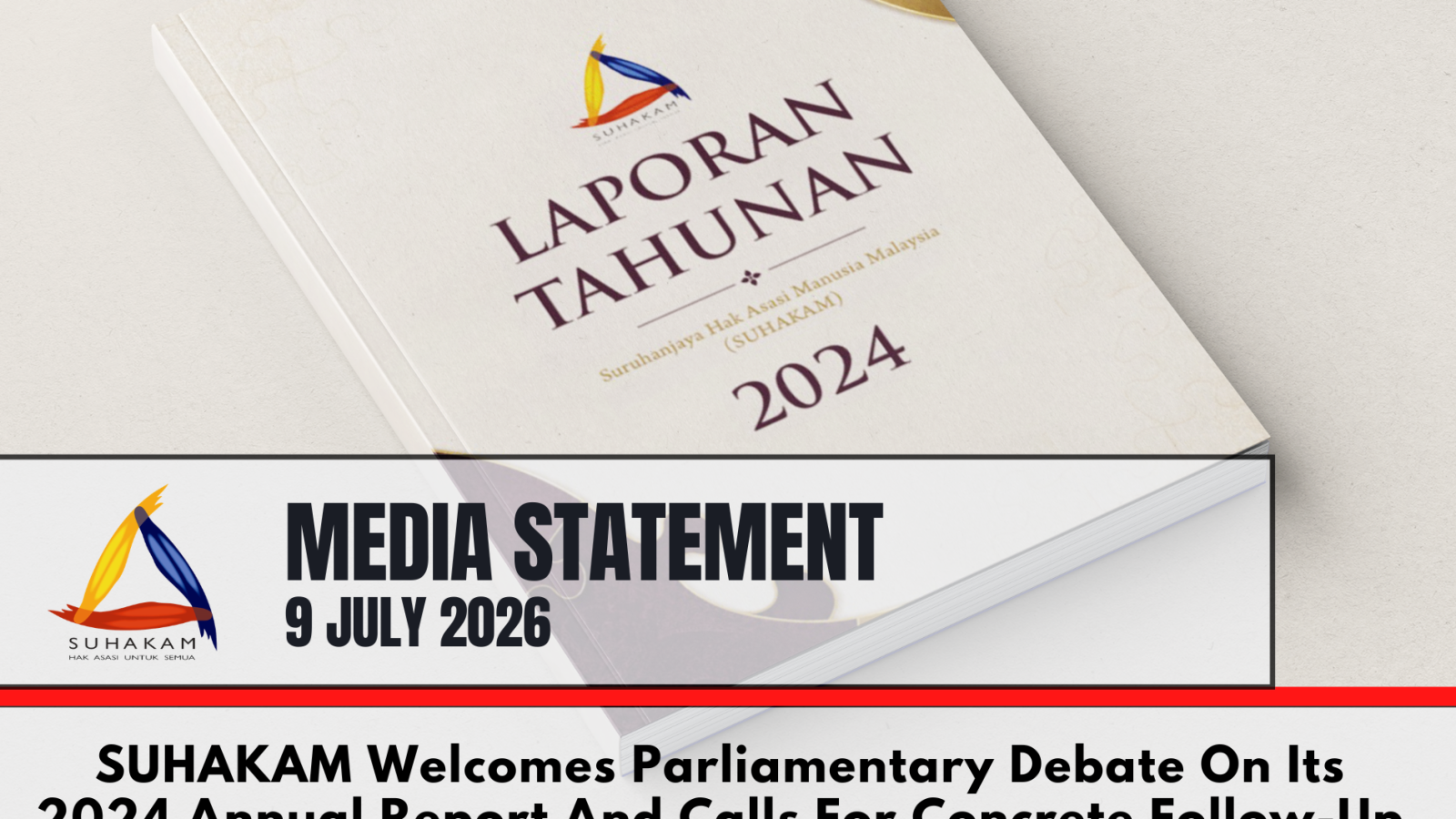
Media Statement No. 42-2026_SUHAKAM Welcomes Parliamentary Debate On Its 2024 Annual Report And Calls For Concrete Follow-Up Action

KUALA LUMPUR (9 JULY 2026) – The Human Rights Commission of Malaysia (SUHAKAM) welcomes the tabling and debate of its 2024 Annual Report in the Dewan Rakyat on 7 and 8 July 2026, with the participation of 36 Members of Parliament who deliberated on a broad range of human rights issues affecting the nation. The debate reflects Parliament’s continuing commitment to ensuring that human rights remain an integral part of Malaysia’s governance and democratic accountability. 

SUHAKAM records its sincere appreciation to YB Dato’ Seri Azalina Othman Said, Minister in the Prime Minister’s Department (Law and Institutional Reform), for moving the motion to table and debate the Annual Report, reaffirming the Government’s commitment to advancing, protecting and fulfilling human rights in accordance with the Federal Constitution, the rule of law and the public interest. SUHAKAM also expresses its special gratitude to YB Tuan M. Kulasegaran A/L V. Murugeson, Deputy Minister in the Prime Minister’s Department (Law and Institutional Reform), for concluding the debate and for his unwavering dedication to advancing the human rights agenda for the benefit of all Malaysians.

Throughout the two-day debate, Members of Parliament from both sides of the House demonstrated strong engagement by deliberating on a broad range of human rights concerns and institutional reforms. The key issues raised included:

  1. Strengthening SUHAKAM’s statutory powers, including enhancing its investigative and monitoring functions, ensuring timely and substantive responses to its recommendations by ministries and agencies, and increasing financial and institutional support to enable the Commission to effectively discharge its mandate.
  2. ⁠Protecting the rights of children and other vulnerable groups, including women, older persons, persons with disabilities, Indigenous Peoples and migrant workers, as well as advancing reforms to the juvenile justice system and broader economic, social and cultural rights.
  3. Enacting a comprehensive legal and policy framework on refugees.
  4. Strengthening human rights education and capacity-building through the implementation of ATHAM 2.0, expansion of human rights training modules, and integration of human rights education within the national education system.
  5. Advancing prison and detention reforms, including improving conditions of detention, addressing deaths in custody, enhancing transparency and accountability, and strengthening rehabilitation, parole and reintegration programmes.
  6. Protecting the rights and welfare of gig workers, including fair working conditions, occupational safety, social protection, income security and effective dispute resolution mechanisms.
  7. ⁠Addressing issues relating to citizenship, documentation and access to legal identity, particularly for individuals facing barriers to obtaining identity documents and accessing essential public services.
  8. Strengthening human rights safeguards within drug rehabilitation and treatment programmes by promoting dignity, evidence-based practices and respect for human rights.
  9. ⁠Addressing human rights challenges affecting rural and underserved communities, including equitable access to infrastructure, essential services and sustainable development opportunities.
  1. Enhancing inter-agency coordination, policy coherence and whole-of-government cooperation in advancing and protecting human rights.
  2. Promoting stronger collaboration between Parliament, the Government and independent institutions to ensure the effective implementation of human rights commitments and recommendations.

SUHAKAM welcomes the constructive and substantive nature of the debate, which reflects the growing recognition that human rights issues cut across all sectors and require coordinated action by the Government, Parliament and all relevant stakeholders. SUHAKAM emphasises that the Annual Report is an important accountability mechanism that assesses the country’s human rights situation, identifies systemic challenges and offers practical recommendations to strengthen the protection and promotion of human rights. The 2024 Annual Report highlights eleven core areas of focus:

  1. Institutional reform and strengthening human rights protection
  2. ⁠Rights of children and vulnerable groups.
  3. ⁠Citizenship and statelessness.
  4. ⁠Refugees and migrants.
  5. ⁠Deaths in custody and conditions of detention centres.
  6. ⁠Indigenous Peoples’ rights and customary land.
  7. ⁠Rights of persons with disabilities, women and gender equality.
  8. ⁠Human rights education and awareness.
  9. ⁠Legislative and policy reforms.
  10. Business and human rights.
  11. International human rights engagement.

SUHAKAM acknowledges the constructive responses and commitments from various ministries and agencies on pressing human rights matters. SUHAKAM therefore hopes that the concerns, recommendations and proposals raised during the parliamentary debate will be translated into concrete policies, legislative reforms and administrative measures by the relevant ministries and agencies. Meaningful implementation of these recommendations will further strengthen public institutions, enhance accountability and improve the protection of the rights and dignity of everyone in Malaysia. SUHAKAM stands ready to work collaboratively with the Government, Parliament and all stakeholders to monitor progress and advance a human rights-based approach to governance.

-END-

Human Rights Commission of Malaysia (SUHAKAM)

9 July 2026

1

[OCC] Media Statement No. 40-2026_The Children’s Commissioners Express Concern Over School Stabbing Incident and Urge Protection of Children’s Privacy

KUALA LUMPUR (7 JULY 2026) – The Children’s Commissioners (CC) of the Human Rights Commission of Malaysia (SUHAKAM) express their deep concern over the recent stabbing incident involving students at a secondary school in Banting, Selangor. We extend our heartfelt sympathies to the child who was injured and wish her a full and speedy recovery. We also acknowledge the emotional distress experienced by the families, school community, and all children affected by this tragic incident.

The CC emphasise that both the victim and the alleged perpetrator are children and are therefore entitled to the protection and safeguards afforded under Malaysian law and the United Nations Convention on the Rights of the Child (CRC), which Malaysia is a party to since 1995. While the incident is currently under police investigation, it is imperative that the rights, dignity, and best interests of every child involved are fully respected throughout the legal process.

The CC are particularly alarmed by the widespread circulation of photographs, videos, personal information, and unverified claims relating to the children involved on social media and messaging platforms. Such actions can cause lasting psychological harm, expose children to public stigma, interfere with investigations, and compromise their rehabilitation and future reintegration into society.

The public, media organisations, and all online users are reminded that Section 15 of the Child Act 2001 prohibits the publication or dissemination of any information that may lead to the identification of a child involved in proceedings or matters protected under the Act. This prohibition extends to names, photographs, videos, school details, family information, addresses, or any other particulars capable of revealing the identity of the child. Any person who contravenes subsection this provision commits an offence and shall on conviction be liable to a fine not exceeding ten thousand ringgit or to imprisonment for a term not exceeding five years or to both.

The CC further urge the public to refrain from speculation regarding the circumstances of the case, including the child’s medical condition, disability, mental health, or alleged motive. Such speculation is irresponsible, risks prejudicing ongoing investigations, and may perpetuate harmful stereotypes and discrimination.

Recent media reports indicate that the suspect’s legal counsel has stated that the child is autistic.

Should this information be confirmed, the OCC stresses that disability must never be used to stigmatise, vilify, or incite hatred against any child. Every child, including children with disabilities, has the right to equal protection before the law, dignity, non-discrimination, and access to appropriate support services.

This incident should also serve as a reminder of the importance of strengthening violence prevention measures in schools through early identification of risk factors, accessible mental health and psychosocial support, effective child protection mechanisms, collaboration between schools, parents, and relevant agencies, and timely interventions that address the needs of vulnerable children before crises occur.

The CC will continue to monitor developments closely and engage with the relevant authorities to ensure that the rights and welfare of all children involved are safeguarded in accordance with the Child Act 2001, the Anti-Bullying Act 2026, the Convention on the Rights of the Child, and other applicable laws.

The Children’s Commissioners call upon every member of the public to act responsibly by refraining from sharing or forwarding any content that identifies or exploits children. Protecting children extends beyond ensuring their physical safety—it also requires safeguarding their privacy, dignity, and future.

-END-

Office of the Children’s Commissioner (OCC)
Human Rights Commission of Malaysia (SUHAKAM)

7 July 2026

2

Media Statement No. 29-2026_SUHAKAM Calls For Greater Digital Accessibility And Inclusion In Conjunction With Global Accessibility Awareness Day 2026

KUALA LUMPUR (21 MAY 2026) – In conjunction with Global Accessibility Awareness Day (GAAD) 2026, the Human Rights Commission of Malaysia (SUHAKAM) reaffirms the importance of ensuring equal access to digital spaces, information, and technology for all persons, particularly persons with disabilities (PWDs).

Observed annually on the third Thursday of May, GAAD serves as a global reminder of the urgent need to advance accessibility and inclusion in the digital environment. As Malaysia continues to expand its digital ecosystem, accessibility must remain a fundamental human rights consideration and not an afterthought.

SUHAKAM emphasises that access to information, communication, education, employment, public services, and participation in public life increasingly depends on digital platforms and technologies. However, many persons with disabilities continue to face barriers due to inaccessible websites, mobile applications, online services, and communication systems. We wish to reiterate that digital accessibility is intrinsically linked to the principles of equality, dignity, non-discrimination, and meaningful participation as guaranteed under the Federal Constitution and reinforced through Malaysia’s obligations under the Convention on the Rights of Persons with Disabilities (CRPD).

SUHAKAM therefore calls upon:

i.          Government agencies to strengthen inclusive digital governance and ensure all public digital platforms comply with universal accessibility standards;

ii.         Private sector actors, technology developers, and service providers to embed accessibility features into the design and development of digital products and services;

iii.       Educational institutions and workplaces to promote digital inclusion and accessible learning and working environments; and

iv.        Society at large to foster greater awareness, empathy, and understanding towards the lived experiences of persons with disabilities.

SUHAKAM also encourages stronger collaboration between policymakers, civil society organisations, disability advocates, and industry stakeholders in building a digital ecosystem that leaves no one behind.

An inclusive and accessible digital environment is essential to achieving a just, equitable, and human rights-based society. In embracing technological progress, Malaysia must ensure that all individuals, regardless of ability, are able to participate fully and equally in the digital age.

-END-

Human Rights Commission of Malaysia (SUHAKAM)

21 May 2026

Copy of Template PS 1 (Facebook Post (Landscape)) (1)

Press Statement No. 33-2023_A Gift For Our Children in Conjunction with Malaysia Day

A Gift For Our Children in Conjunction with Malaysia Day

PRESS STATEMENT

KUALA LUMPUR (15 SEPTEMBER 2023) – Since the establishment of the Office of the Children’s Commissioner in 2019, the highest complaints received by this office is child protection issues whilst protection connotes protection from sexual offences, abuse, and negligence. The complaints of sexual assault are chronically critical on account of the traditional resolution of problems done through the payment of penance (village mode), sodomy committed against students by teachers, and a few sexual and physical abuse cases against children in shelter homes. These are the few cases that were being reported, not to mention the cases that went unreported.

The abovementioned cases were successfully channelled and acted by the relevant authorities owing to this office’s role and function as an oversight body in coordinating all relevant parties to uphold justice and protect children. However, this office will continue to work restrictively if it is still inadequately resourced, nonindependence and with deficiency in capacity and complaint system.

Henceforth, the establishment of an independent Children Commission with its act is crucial in protecting and promoting the rights of all children in Malaysia holistically and systematically. To date, more than 50 countries worldwide have established their respective oversight bodies for children. It does not only limit at the national level namely New Zealand and Norway, but they could also be found at the local level such as Australia and the United States of America, taking into account the local context. Despite its children population is lesser than Malaysia, New Zealand and Australia are bequeathed with various oversight bodies for the rights of child at the national and local level, demonstrating the placement of children’s rights at the heart of every development in the countries.

In welcoming the 60th Malaysia Day tomorrow, it is timely that a gift of a Children Commission to the children of Malaysia be realised. A Children Commission that is endowed with the function and mandate enshrined in a specific act will become a body with the responsibility to advocate and enhance the rights of child, specifically children of the vulnerable community including persons with disabilities and rural communities in Sabah and Sarawak. Thus, OCC would like to appeal to have the gift for all children in Malaysia to be presented as the testimony of Malaysia Day that has been overdue.

-END-

Dr Farah Nini Dusuki

Children’s Commissioner 

15 September 2023

———————

Hadiah Untuk Kanak-kanak Sempena Hari Malaysia

KENYATAAN MEDIA

KUALA LUMPUR (15 SEPTEMBER 2023) – Sejak Pejabat Pesuruhjaya Kanak-kanak (OCC) ditubuhkan pada tahun 2019, antara aduan tertinggi diterima OCC ialah berkaitan hak kanak-kanak kepada perlindungan, dan perlindungan yang dimaksudkan ialah daripada jenayah seksual, penderaan, pengabaian dan kecuaian. Aduan jenayah seksual amat kritikal kerana sebahagiannya melibatkan jumlah kanak-kanak yang ramai di kawasan pedalaman yang secara tradisinya kes diselesaikan secara pembayaran wang sogit (cara kampung), liwat melibatkan sejumlah pelajar sekolah oleh guru, dan beberapa kes pukul dan liwat terhadap penghuni oleh kakitangan di institusi rumah perlindungan kanak-kanak. Ini cumalah sebahagian kecil daripada kes yang dilaporkan dan jumlah kes yang tidak dilapor tentulah lebih banyak lagi.

Kes-kes di atas telah berjaya diketengahkan dan diambil tindakan wajar oleh semua pihak berwajib kerana OCC telah memainkan peranan menjadi badan yang menyelaras semua pihak berkaitan untuk saling bekerjasama bagi menegakkan keadilan dan memberi perlindungan kepada mangsa kanak-kanak. Walau bagaimanapun, OCC tidak dapat melakukan tugas ini secara meluas jika masih dikekang dengan peruntukan yang tidak mencukupi, tiada Akta sendiri, dan kapasiti dan sistem aduan yang penuh serba kekurangan.

Justeru itu, penubuhan Suruhanjaya kanak-kanak yang bebas dengan Akta tersendiri amat penting supaya perlindungan dan promosi hak semua kanak-kanak di Malaysia dapat dilaksanakan secara lebih menyeluruh dan sistematik. Telah ada lebih daripada 50 negara di dunia ini masing-masing memiliki sekurang-kurangnya satu badan pemantauan hak kanak-kanak. Sesetengah badan pemantauan hak kanak-kanak telah ditubuhkan di peringkat kebangsaan misalnya New Zealand dan Norway. Manakala di Australia dan Amerika Syarikat, setiap Kerajaan Negeri menubuhkan Suruhanjaya Kanak-Kanak mereka sendiri dengan mandat khusus berdasarkan acuan tempatan dalam negara mereka. Terdapat negara yang jumlah kanak-kanaknya jauh lebih sedikit berbanding Malaysia seperti New Zealand dan Australia, tetapi mereka mempunyai pelbagai badan pemantauan hak kanak-kanak di peringkat kebangsaan dan negeri kerana isu kanak-kanak merupakan antara isu terpenting negara mereka.

Malaysia bakal menyambut Hari Malaysia yang ke 60 esok. Sudah tiba masanya penubuhan Suruhanjaya Kanak-kanak sebagai satu hadiah khusus untuk kanak-kanak di Malaysia direalisasikan. Suruhanjaya Kanak-kanak yang dihasratkan dengan fungsi dan mandat yang termaktub dalam satu Akta khusus, akan menjadi satu-satunya badan yang bertanggungjawab memperjuangkan hak kanak-kanak, khususnya kanak-kanak golongan rentan termasuk kurang upaya dan tinggal di pedalaman Sabah dan Sarawak. Oleh itu OCC merayu agar hadiah untuk semua kanak-kanak ini benar-benar menjadi kenyataan sempena Hari Malaysia yang amat dinantikan.

-TAMAT-

Dr Farah Nini Dusuki

Pesuruhjaya Kanak-Kanak

15 September 2023

PS

Press Statement No. 12-2021 (OCC)_CC is Saddened by the Government’s Decision to Appeal the Kuala Lumpur High Court’s Judgment on Suriani Kempe Case

PRESS STATEMENT

KUALA LUMPUR (27 SEPTEMBER 2021)   –   The Children’s Commissioner of the Human Rights Commission of Malaysia (SUHAKAM), Prof Dato’ Noor Aziah Mohd Awal (CC) is saddened by the Government’s decision to appeal and file an application to stay the execution of the Kuala Lumpur High Court’s judgment on the granting of automatic citizenship to children born abroad to Malaysian women married to foreign spouses – the Suriani Kempe Case. That decision had, in fact been supported by five ministers, namely the Ministry of Women, Family and Community Development (KPWKM); Prime Minister’s Department (Parliament & Law); Ministry of Plantation Industries and Commodities (MPIC); Ministry of Communications and Multimedia (KKMM); and Ministry of Welfare, Community Wellbeing, Women, Family and Childhood Development, Sarawak (KWKPK).

The Minister of Home Affairs had stated, in Parliament, the Government’s intention to amend the Federal Constitution (FC) but, in subsequent press release had stated that an appeal to the High Court’s decision was submitted to avoid the Government from being subjected to contempt of court, as well to comply with the provisions of the FC. The Ministry also said that the decision of Suriani Kempe case was in conflict with the decision of the Mahisha Sulaiha case in 2020 and the Federal Court decision on CTEB (Chan Tai Ern Bermillo) case which was decided on early this year. The same press release had also informed that the Attorney General would seek an audience with the Deputy YDPA on the matter.

The CC however finds the argument given by Ministry of Home Affairs is untenable because:

  1. High Courts are not bound to another High Court’s decision;
  2. The CTEB case must be distinguished with that of Suriani Kempe’s, as CTEB was on illegitimate child whose mother was a foreigner and was then legitimated by subsequent marriage of the biological father and mother;
  3. The issue of the High Court Judge Suriani Kempe’s case, having to amend the Constitution is irrelevant, as a Judge has the power to interpret the provisions of the law, including the FC, for justice to prevail.

The Judge was, in fact, interpreting Article 8(2) of the FC which is seen to be in conflict with Article 14(1) (b).  By not appealing and instead opting to enforce the High Court decision, the Government would be seen to be serving the best interest of children according to Article 3 of the Convention of the Rights of Child (CRC), as well as ending the denial of mothers and children their citizenship, who have suffered for far too long. The issue has since been discussed in Parliament where many MPs also supported the recent High Court’s decision and had urged the Government not to proceed with the appeal.

The CC reiterates there is real issue of gender discrimination in relation to nationality under Article 14(1)(b) of the FC, to children born overseas whose mother is Malaysian and foreign father. The CC acknowledges that any amendment to the FC requires the approval of the Conference of Rulers in accordance with Article 159(5). However, that should not be the reason to delay the amendment, as any delays ultimately translate to continued denial of these women’s rights and further suffering amongst their children.  The CC appeals to the Government, and MOHA in particular, to expedite the application for citizenship process under Article 14 and 15 of the FC, thereby parties involved would not need to take matters to court until the FC is amended.

-END-

Professor Dato’ Noor Aziah Hj. Mohd Awal, Children’s Commissioner

27 September 2021

Media queries: Contact Mrs. Norashikin Hamzah at 03-2612 5687 / 019-621 5336 or shikin@suhakam.org.my

KENYATAAN MEDIA

KUALA LUMPUR (27 SEPTEMBER 2021)   –   Pesuruhjaya Kanak-Kanak, Suruhanjaya Hak Asasi Manusia Malaysia (SUHAKAM), Prof Dato’ Noor Aziah Mohd Awal (CC) berasa dukacita dengan keputusan Kerajaan untuk mengemukakan rayuan dan memfailkan permohonan untuk menangguhkan pelaksanaan keputusan Mahkamah Tinggi Kuala Lumpur berhubung pemberian kewarganegaraan secara automatik kepada anak yang dilahirkan di luar negara oleh wanita warganegara Malaysia yang berkahwin dengan pasangan warga asing – kes Suriani Kempe. Keputusan Mahkamah itu bahkan telah disokong oleh lima orang menteri, iaitu dari Kementerian Pembangunan Wanita, Keluarga dan Masyarakat (KPWKM); Jabatan Perdana Menteri (Parlimen & Undang-Undang); Kementerian Perusahaan Perladangan dan Komoditi (MPIC); Kementerian Komunikasi dan Multimedia (KKMM); dan Kementerian Kebajikan, Kesejahteraan Komuniti, Wanita, Keluarga dan Pembangunan Kanak-Kanak, Sarawak (KWKPK).

Menteri Dalam Negeri telah menyatakan di Parlimen, akan hasrat Kerajaan untuk meminda Perlembagaan Persekutuan (PP). Walau bagaimanapun, dalam satu kenyataan media beliau berikutnya, beliau telah menyatakan bahawa rayuan terhadap keputusan Mahkamah Tinggi tersebut dibuat bagi mengelakkan Kerajaan dari dikaitkan dengan tindakan menghina Mahkamah, serta demi mematuhi peruntukan PP. Kementerian juga mengatakan bahawa keputusan kes Suriani Kempe adalah bertentangan dengan keputusan kes Mahisha Sulaiha pada tahun 2020 dan keputusan Mahkamah Persekutuan berkenaan kes CTEB (Chan Tai Ern Bermillo) yang diputuskan pada awal tahun ini. Di dalam kenyataan media yang sama juga, adalah difahami bahawa Peguam Negara akan menghadap Timbalan Yang di-Pertuan Agong (YDPA) berhubung perkara ini.

CC bagaimanapun berpandangan bahawa hujah yang dikemukakan oleh Kementerian Dalam Negeri adalah tidak kukuh kerana:

  1. Mahkamah Tinggi adalah tidak terikat dengan keputusan Mahkamah Tinggi yang lain;
  2. Kes CTEB mesti dibezakan dengan kes Suriani Kempe, kerana CTEB adalah berkenaan anak tidak sah taraf yang mana ibunya adalah warganegara asing, yang kemudiannya telah disahtarafkan oleh perkahwinan terkemudian bapa kandung dan ibunya;
  3. Berhubung isu Hakim Mahkamah Tinggi di dalam kes Suriani Kempe yang dikatakan telah meminda PP, ia adalah tidak relevan untuk dipertikaikan, memandangkan seorang Hakim adalah berhak untuk menafsirkan peruntukan undang-undang, termasuk PP, agar keadilan dapat ditegakkan.

Hakim tersebut bahkan telah mentafsirkan Perkara 8 (2) PP yang dilihat bertentangan dengan Perkara 14 (1) (b). Dengan tidak memfailkan rayuan dan sebaliknya memilih untuk menguatkuasakan keputusan Mahkamah Tinggi tersebut (Suriani Kempe), pihak Kerajaan akan dilihat telah mengutamakan kepentingan terbaik kanak-kanak berdasarkan Perkara 3 Konvensyen Mengenai Hak Kanak-Kanak (CRC), serta menamatkan penafian hak para ibu dan anak-anak mereka kepada kewarganegaraan, yang telah menderita dalam tempoh yang cukup lama. Isu ini juga telah dibahas di Parlimen di mana ramai ahli parlimen juga telah menyokong keputusan Mahkamah Tinggi baru-baru ini (Suriani Kempe), dan telah mendesak Kerajaan untuk tidak meneruskan rayuan.

CC mengulangi bahawa sememangnya terdapat isu diskriminasi gender yang jelas berhubung kewarganegaraan dalam peruntukan di bawah Perkara 14 (1) (b) PP, kepada kanak-kanak yang lahir di luar negara oleh ibunya yang berwarganegara Malaysia dan ayah berwarganegara asing. CC akur bahawa setiap pindaan pada PP memerlukan persetujuan dari Majlis Raja-Raja berlandaskan Perkara 159 (5) PP. Walaubagaimanapun, itu tidak sewajarnya menjadi alasan untuk menangguhkan pindaan tersebut, kerana setiap kelewatan akhirnya akan menyebabkan penindasan berterusan terhadap hak-hak wanita ini dan memanjangkan penderitaan dalam kalangan anak-anak mereka. CC memohon kepada pihak Kerajaan dan Kementerian Dalam Negeri khususnya, untuk mempercepatkan proses permohonan kewarganegaraan berdasarkan Perkara 14 dan 15 PP, agar pihak-pihak yang terlibat tidak perlu membawa permohonan mereka ke muka pengadilan sehingga PP dipinda.

-TAMAT-

Professor Dato’ Noor Aziah Hj. Mohd Awal, Pesuruhjaya Kanak-Kanak

27 September 2021

Pertanyaan Media: Sila hubungi Pn. Norashikin Hamzah melalui 03-2612 5687 / 019-621 5336 atau shikin@suhakam.org.my